
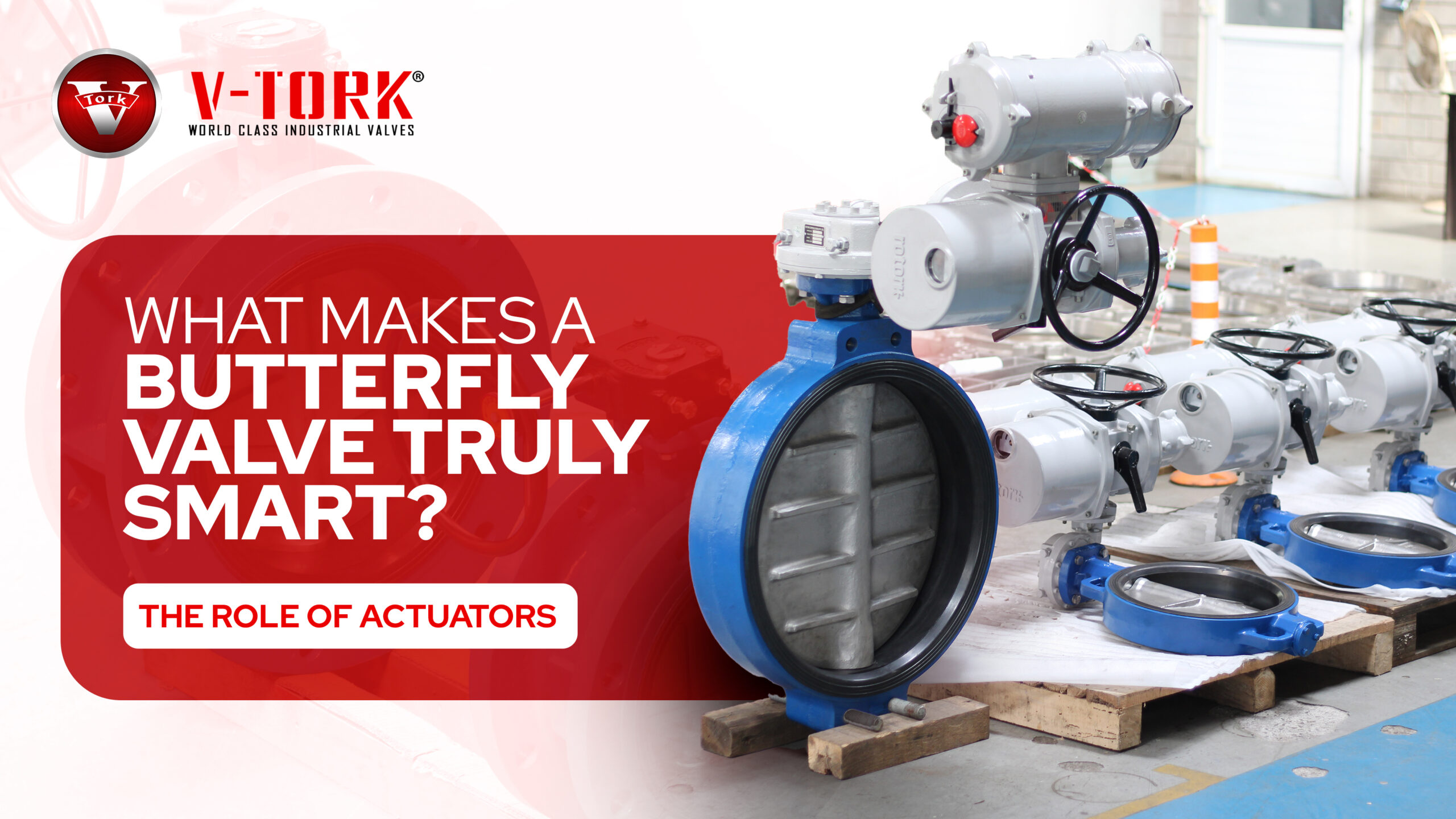
What Makes a Butterfly Valve Truly Smart? The Role of Actuators
In industrial flow control, the valve shuts automatically during failures to prevent uncontrolled flow. The actuator, which operates the valve, is also very important and plays a significant role in the whole process. A “smart” butterfly valve, therefore, is not just about the shape of the disc or the type of body material. It is a valve combining a highly precise valve with an actuator that can carry out operations in a controlled, reliable, and repeatable way, even in tough industrial conditions. Many Coimbatore valve manufacturing companies now focus on actuator-driven automation for better process reliability.
The importance of this cannot be overstated in industries like power generation, mining, water and sewerage treatment, chemical and fertilizer processing, cement, paper and pulp, sugar and starch, and oil and gas, where the performance of an actuator determines the continuity of a process, the efficiency of an automation system, and the safety during operations.
What Does an Actuator Do?
The main role of an actuator is to change the fluid (pneumatic, electric, or hydraulic) energy into rotational motion that is used for moving the butterfly valve disc. Since the butterfly valves operate via a quarter-turn motion, the accuracy of an actuator over repeated cycles plays an important role in ensuring that flow control remains consistent. A butterfly valve used in industry must deliver accurate quarter-turn operation across repeated cycles.
Pneumatic Actuators
By using compressed air, pneumatic actuators run the valve through piston mechanisms. In situations demanding quick reaction and fail-safe operation, they are the first choice. In process industries, they are especially found in places where the reliability of emergency shutdowns and cycling frequency are priorities.
Electric Actuators
Electric actuators work via a combination of motor and gear assemblies and are linked to control systems. Actuators like this can be used in situations where remote running, distributed control systems (DCS), and automation-heavy plants are concerned. Modulated operation and programmable torque control can also be realised through them.
Hydraulic Actuators
In order to operate large-diameter valves under high-pressure conditions, hydraulic actuators provide a large output torque. These types of systems are most often found in heavy industrial and offshore environments.
Worm Gear Drives
Worm gear mechanisms are usually manual actuation options for bigger valves where a mechanical advantage is necessary, but a full automation setup is not available.
The Significance of Fail-Safe Setup
A fail-safe setup is probably the most vital technical decision when selecting an actuator. It defines the position of the valve in the event of a power or control signal loss.
Fail-Open Setup
- If a valve needs to keep flowing even when the actuator breaks down, this is the setup that is used.
Fail-Closed Setup
- For very dangerous or isolation systems, the valve shuts by itself during failures to prevent uncontrolled flow, which is the fail-closed arrangement.
Stay-Put Setup
In this setup, when a failure occurs, the valve is kept at its last working position. This is appropriate when risks are not caused by having the valve either open or closed.
An erroneous fail-safe arrangement can cause both operational and safety problems. For industrial applications, such a decision should be made at the system design stage and not after commissioning.
Accuracy at the Valve–Actuator Interface
What happens at the interface between the valve and actuator has a direct effect on the reliability of the operation. The use of standardized mounting flanges makes it easy to match actuators with valves and also allows for future upgrades without having to change the valve.
Running the actuator at the correct level is just as crucial. Doing this may not be possible if the actuators are too small, whereas oversized actuators can cause damage to the valve stems and sealing components. Accurately calculating the torque by considering pressure conditions, cycle frequency, and fluid characteristics helps ensure that the valve lasts for a long time. Every butterfly valve used in industry depends on the right actuator for dependable performance.
In the case of industries where slurry or high-viscosity media handling is their daily routine, the torque requirement may go up significantly. Normally, under these circumstances, pneumatics with a higher torque capacity are the ones selected for continuous valve operation.
Integration with Industrial Automation Systems
Today’s industrial plants can hardly operate without constant monitoring and automatic control. To fulfill these requirements, smart actuators are not merely control valves, but also act as a link to DCS and SCADA systems. Among Coimbatore valve manufacturing companies, there is a growing demand for actuated solutions that support DCS and SCADA integration.
Position indicators, limit switches, solenoid valves, and positioner modules are some of the accessories that make process monitoring and operation feedback quite accurate. This kind of integration leads to better process visibility, minimizes the risk of downtime, and allows the implementation of predictive maintenance strategies.
For industrial clients, getting a pre-integrated actuated valve assembly is the way to go, as it also makes the installation easier and the commissioning operation more efficient.
Final Thought
To conclude, the real capability of a butterfly valve is a function of the whole combination – valve, actuator, automation integration, and fail-safe configuration working harmoniously. Efficient torque control, proper positioning, and high system compatibility are the features of an outstanding industrial valve solution.
We at V-Tork Controls produce a wide range of butterfly valves, including Concentric (C-Series), Double Eccentric (2X-Series), and Triple Eccentric (3X-Series) series, which can be equipped with pneumatic, electric, hydraulic, and worm gear actuation systems to meet very demanding industrial working conditions.
Industries that rely on precise actuated butterfly valve solutions designed for automation and that can ensure performance over time should consider V-Tork Controls as their partner, as we provide engineered systems that are based on real operating conditions.