
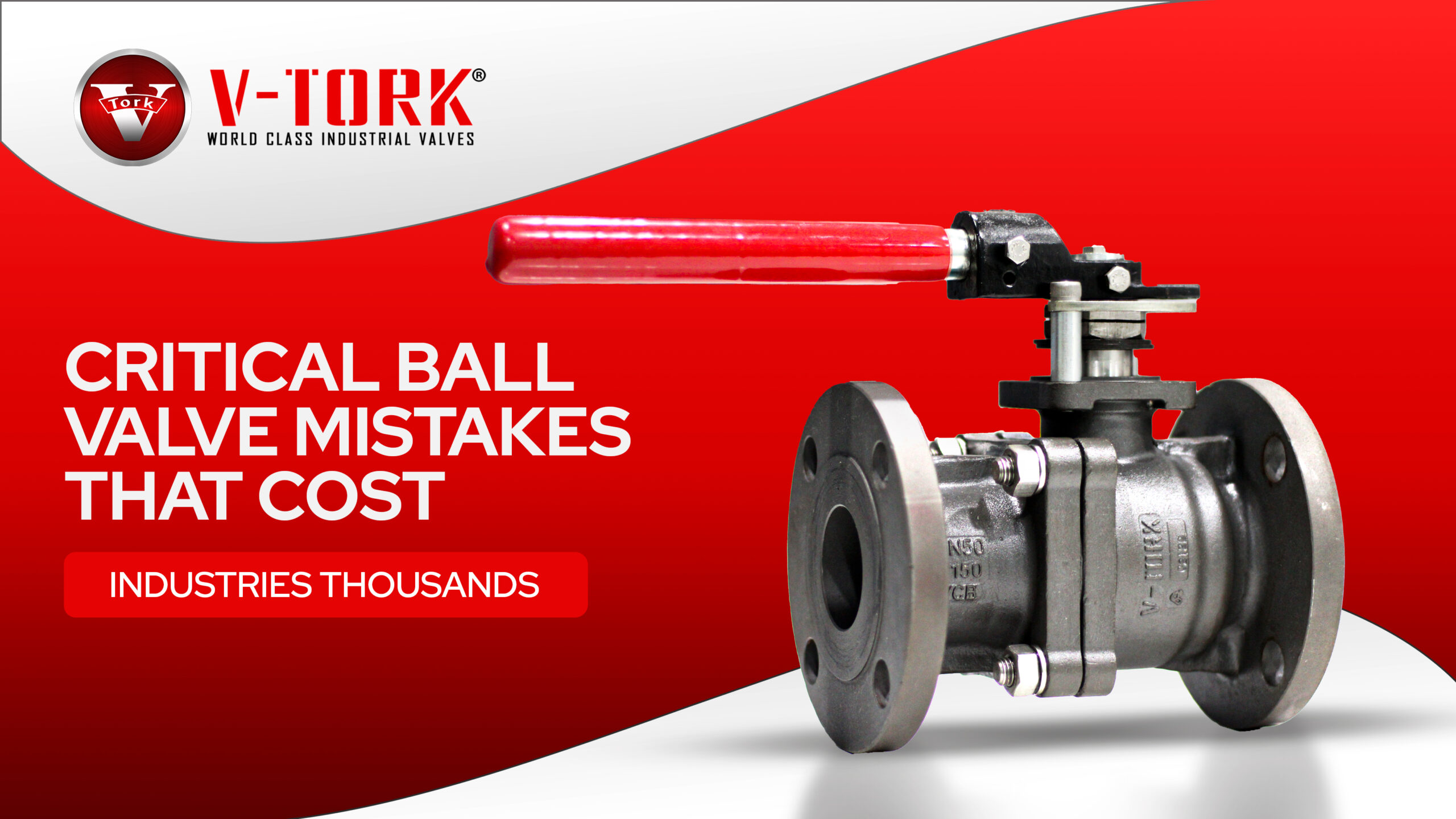
Critical Ball Valve Mistakes That Cost Industries Thousands
In critical process industries such as power generation, oil & gas, chemical, metal & mining, water treatment, and pulp & paper, controlling fluid flow is no trivial matter. Each element in the flow is a part of the operational and financial bottom line. And the ball valve is one of the most trusted and, unfortunately, most misused components. The ongoing mistakes in specification, installation, and maintenance all lead to unscheduled outages, regulatory issues, and repair costs in the thousands.
This is a common theme we observe across industries. In this blog, we will discuss the key errors – not in theory, but in practice.
Selecting the Wrong Pressure Rating
One of the most expensive purchasing mistakes is to choose a ball valve based on its pressure rating, without considering the pressure-temperature (P-T) rating at the operating conditions. Higher temperatures lower the material strength of the body, seats, and seals. A valve rated for a certain pressure class at normal temperature will not maintain its integrity at 200°C or higher.
In the power and petrochemical industries, this leads to seat distortion, seal failure, and bypass leakage, all irreversible without complete valve replacement during process shutdown. It is important to cross-check the manufacturer’s P-T chart for the body material, trim, and seat combination, rather than relying solely on the pressure class stamped on the body.
Ignoring End Connection Compatibility
Placing a screwed-end ball valve in a flanged-style system produces stress risers at the junction. Vibration, thermal cycling, and pressure spikes increase fatigue over time, forming leak paths long before the valve reaches the end of its service life.
End connections need to be considered in terms of pipe schedule, system pressure class, and maintenance access. Screwed ends are suitable for lower-pressure and higher-diameter valves; flanged ends are suitable for higher-pressure and diameter valves requiring occasional in-line maintenance.
Overlooking Seat and Seal Material Compatibility
Polytetrafluoroethylene (PTFE) seats are compatible with most chemicals, but not all. Exposure to some oxidising media, high-temperature steam, and strong solvents degrades PTFE seats, eventually resulting in micro-leakage, which may not be discovered until a contamination or safety incident occurs.
In chemical, fertilizer, and pharmaceutical applications, the internal bill of materials for the industrial ball valve (body, ball, seat, O-ring, and stem seal) must be assessed as a system of chemical resistance in relation to the media, concentration, and temperature. This cannot be achieved by evaluating individual components.
Using a Ball Valve in Throttling
Ball valves are designed for shut-off, utilizing one of two positions, with a 90-degree quarter turn. Throttling (partially open) an industrial ball valve results in the ball and seat being exposed to fast-flowing turbulent conditions, resulting in increased erosion and cavitation (in liquid applications).
The result is premature seat failure, loss of tight shut-off, and reduced longevity. If flow control is needed, then an appropriate control valve should be used. Replacing a control valve with a ball valve is a cost-saving design compromise.
Actuator Sizing Mismatches
Using a ball valve with an undersized actuator will result in insufficient shutoff against line pressure, especially at start-up or when the valve’s breakout torque rises due to seat contamination. An oversized actuator results in an excessive push on the stem and seats, leading to premature fatigue over cycling.
The size of the actuator must consider the maximum differential pressure during closure, the service class safety factor, and the required actuation speed. Whether pneumatic, hydraulic, or electric, the actuator’s torque at minimum input conditions must comfortably outperform the valve’s maximum torque under all operating conditions spanning the temperature range of the valve.
Final Thought
To conclude, these errors are caused by the siloed nature of procurement, engineering, and maintenance in organisations with significant resources. The true cost of mis-specification, mis-application, and deferred maintenance is not typically captured as a single figure, but it is evident by lowered plant availability, product quality, and compliance with safety standards.
The key to cost control is to consult with an industrial valve manufacturer at the specification stage, rather than simply cataloguing valve options. V-Tork Controls has specific industry knowledge on power, metal & mining, chemicals, water treatment, paper & pulp, cement, sugar, pharmaceuticals, and oil & gas; designing ball valves and entire valve solutions to meet process and regulatory specifications.
If you are working with a specification, a maintenance program, or ordering bespoke flow control solutions, reach out to V-Tork Controls at vtorkcontrols.com.