
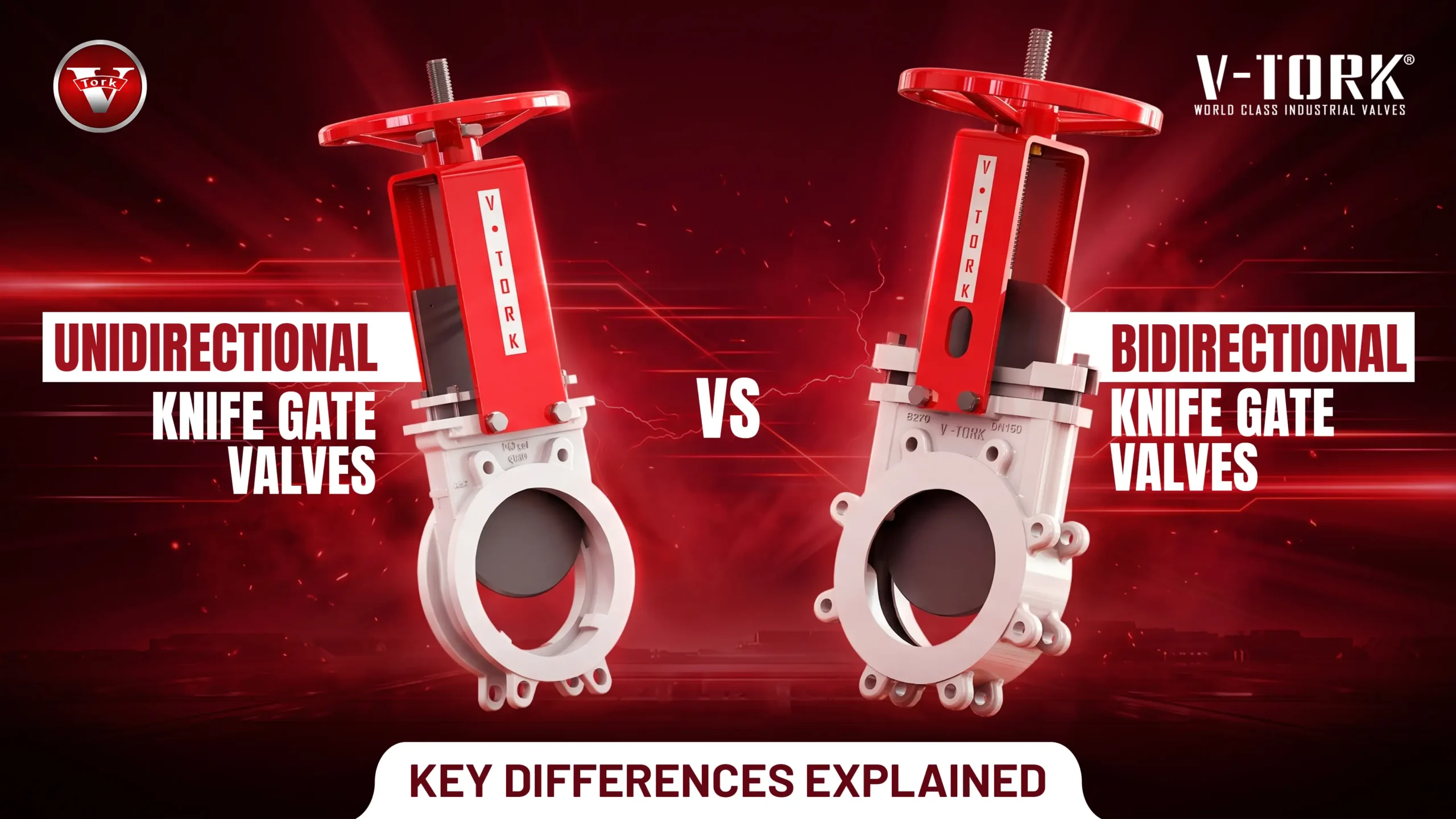
Bidirectional vs. Unidirectional Knife Gate Valves: Key Differences Explained
- A unidirectional knife gate valves is most effective when pressure pushes in only one direction.
- A bidirectional knife gate valve holds from either side, which matters when pressure can reverse.
- Knife gate valve manufacturers in India build both types, so the right one depends on your line, not the catalogue.
Two valves can look almost identical on a drawing. Same blade, same body style. Then one goes into a line where pressure only ever pushes one way, and it runs for years. The other one is put in a line where pressure changes and begins to cry at the seat in just a few weeks. The difference is that one was constructed to seal in and the other to seal out. Let’s see how that works, where it fits, and how to decide without having to guess.
The Real Difference: Which Way the Valve Seals
All knife gate valves operate in the same manner. The gate covers the pipe and is held up against the seat. The change is the way the seal is created.
With the unidirectional design, line pressure on one side forces the gate against the seat, creating pressure-assisted contact. If pressure remains on the right side, it will work. Flip it over, and the valve will tell you now, typically in the form of a drip.
A bi-directional design ensures effective sealing on both sides of the gate. Our B-series bi-directional knife gate valves, for example, feature either a peripheral sealing arrangement or a dual face seal design, ensuring reliable pressure containment regardless of the direction of flow or applied pressure.
When a Unidirectional Knife Gate Valve Makes Sense
If flow only goes one way and there’s no backpressure, a unidirectional valve does the job without any extra complexity.
Our U-series knife gate valves come in wafer, lug, and flanged versions: the U-160, U-250, and U-340. The lug type, U-250 and Flanged type, U-340, allow dead-end service. Seats can be metal-to-metal, a replaceable metal seat for slurries, or a replaceable resilient seat for clean fluids and light-duty slurries. For hot gas and boiler ash, the flanged U-610 has a metal seat and is built to NFPA 85. For water treatment stations, something we covered in our post on knife gate valve selection for wastewater.
You’ll see this series in paper and pulp, cement, mining, power, and steel plants, and on silo emptying lines.
When You Need a Bidirectional Knife Gate Valve
Go bidirectional when pressure can come from either side. Slurry lines with back pressure are the classic case. Sludge lines are another. With a bidirectional pressure rating, you can clear a blocked line from the opposite direction,
The B-series covers different layouts. The B-540 is a lug type with a short face-to-face. The B-720 is flanged with a long face-to-face. The B-630 has an O-port, and the B-900 is a two-piece transverse seal concept rugged body. On the B-series, sizes run from 2 to 64 inches, with pressure ratings from 10 bar to 100 bar. Seals come in Nitrile, EPDM, Viton, Natural rubber, or Silicone.
Side by Side
| Unidirectional | Bidirectional | |
| Pressure from | One side | Either side |
| How it seals | Pressure-assisted against the seat | Peripheral sealing or a dual-face sealing |
| Seat options | Metal or resilient | Resilient |
| Application Type | Steady one-way flow | Slurry with backpressure |
Matching the Valve to Your Knife Gate Valve Application
Four questions sort out most cases.
- Can pressure ever reverse, even briefly? If yes, go bidirectional.
- How abrasive is the media? That decides the seat: metal, resilient, or elastomer.
- Do you need dead-end service or room to maintain the valve? A lug/flanged type is worth a look.
- What does the line pressure actually reach? Check it against the model’s rating, not the nominal figure.
Get this wrong in one direction and you get leakage and early seat wear. Get it wrong in the other and the valve works, but you may be paying for sealing you never use. Sizing is its own question, and we covered it in our knife gate valve sizing guide. Our buying guide also covers the bonnet and material choices that sit on top of this decision.
Final Thought
Unidirectional and bidirectional valves aren’t rivals. They’re built for different pressure conditions, and the trouble starts when one ends up in the other’s job. Decide which way your pressure can act first, and the rest of the specification gets a lot easier.
At V-Tork Controls, we make both types, and we work with mining, power, paper, water treatment, cement, and chemical plants. As one of the knife gate valve manufacturers in India serving these sectors, we’re happy to look at your knife gate valve application and suggest the right configuration. Reach out to our team at vtorkcontrols.com.