
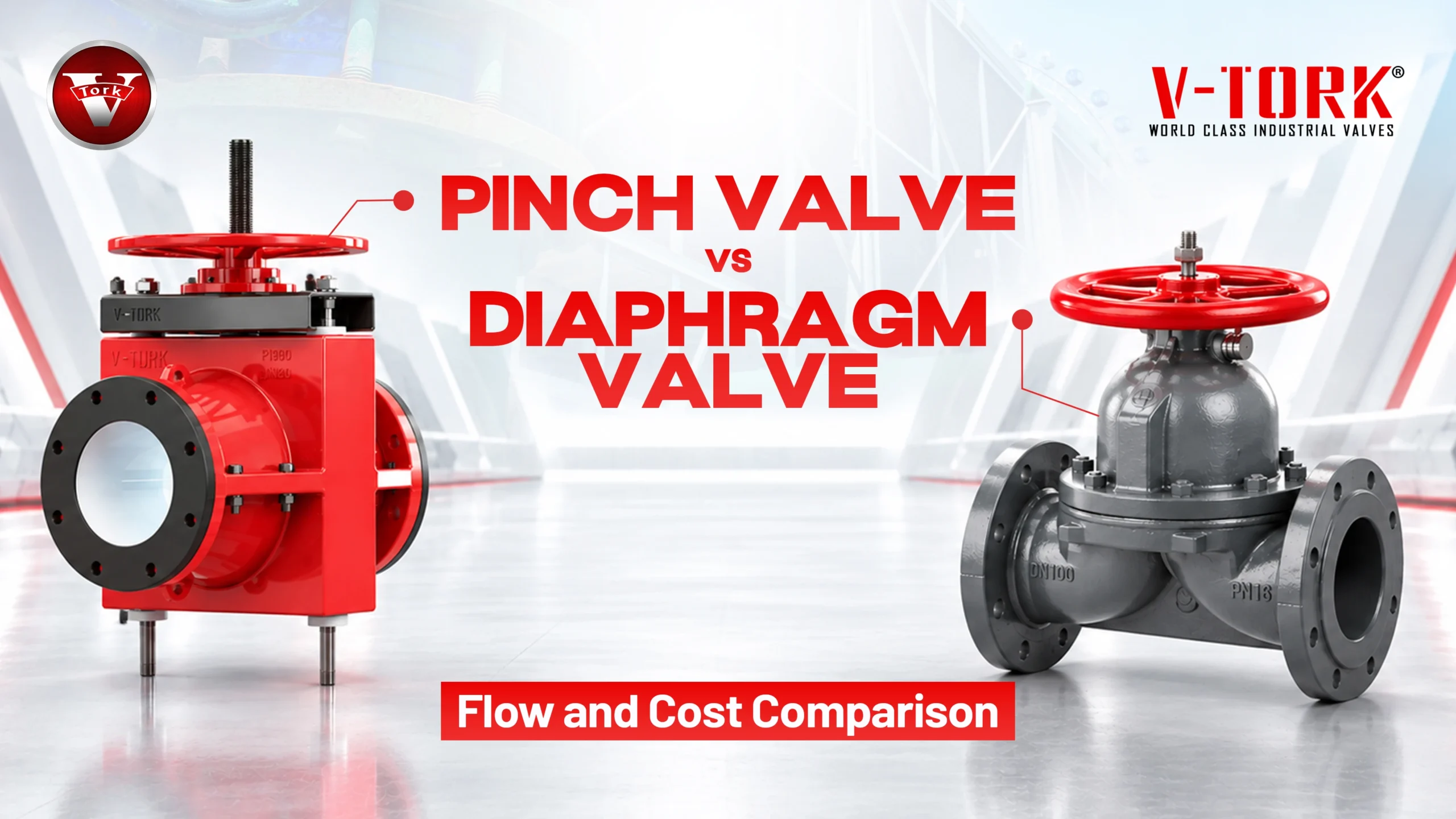
Pinch Valve vs Diaphragm Valve: Flow and Cost Comparison
- Pinch and diaphragm valves both work as flow control valves, but they handle abrasive media very differently.
- Pinch Valve vs Diaphragm Valve mostly comes down to one thing: what’s actually flowing through the line.
- Pick wrong, and you’re replacing the valve sooner than you’d like.
How Each Valve Actually Controls Flow
A diaphragm valve closes when a flexible diaphragm is pressed down onto a weir or seat inside the body, pinching off the flow path from above. A pinch valve works differently, the entire sleeve compresses evenly around the flow pa2th, with no weir, no seat, and no metal surface anywhere near the media. That one design difference is where most of the downstream differences in performance actually come from.
Weir-type diaphragm valves are built for throttling, the diaphragm can be positioned partway to modulate flow, which makes them genuinely good at control applications. Straight-through diaphragm valves skip the weir for a fuller bore, mainly for on-off service. Pinch valves don’t have this split. Every pinch valve gives a full, unobstructed bore, whether it’s being used for isolation or for throttling.
Flow Characteristics: Where Each Valve Performs Better
Diaphragm valves, especially weir-type, offer a more linear and predictable flow control at partial openings and are thus common in dosing and blending applications where precise modulation is important. Pinch valves throttle differently. They show a quick-opening, non-linear curve, and they close by physically displacing solids out of the sealing zone rather than trapping them against a seat.
That difference matters more than it sounds. In a diaphragm valve, the weir is exactly where solids tend to collect, which is fine for clean or lightly loaded fluids but becomes a wear point the moment particulates enter the picture. A pinch valve has nowhere for solids to collect in the first place; the sleeve just closes around whatever is in the line.
Media Compatibility – Abrasive vs Clean Fluids
Typically, this is the sole criterion before cost comes into play. Commonly used for clean, low solids, mildly viscous fluids in water treatment dosing lines, pharmaceutical transfer lines, and food-grade applications, these valves are known as diaphragm valves. After any abrasive load is present in a fluid, the weir and the diaphragm begin to wear irregularly, and service life rapidly decreases.
Diaphragm valves have been the cause of trouble with certain media; hence pinch valves have been developed for just those media. We are experienced valve manufacturers and have tested pinch valves in a variety of applications, including ore tailings, mineral slurries, and corrosive chemical suspensions where a diaphragm valve could not last a typical service interval.
Maintenance and Replacement Cost
Both valve types have a wear component that eventually needs replacing; the diaphragm on one side, the sleeve on the other. Diaphragm replacement on a weir-type valve is generally straightforward on clean service, and replacement intervals can be long if the fluid stays within the valve’s intended range.
Once abrasive media is involved, that comparison changes. A diaphragm under continuous particulate contact wears unevenly around the weir, often needing replacement well before a pinch valve sleeve would, because the sleeve isn’t fighting a fixed seat geometry the same way. On the maintenance side, a two-piece pinch valve body allows sleeve access without pulling the valve off the line, a detail that matters when a shutdown window is short.
Upfront Cost vs Long-Term Cost
On paper, smaller diaphragm valves are often cheaper to purchase, particularly in the sizes and pressure ranges common to clean-service applications. For a flow control valve handling water treatment dosing or similar duty, that lower upfront cost is a legitimate advantage, and there’s no reason to pay more for abrasion resistance you don’t need.
The comparison flips once abrasive or corrosive media is in the line. A diaphragm valve fighting media it wasn’t built for ends up costing more over its service life, more frequent diaphragm replacement, more downtime, and eventually a valve swap the plant wasn’t budgeting for. A pinch valve sized correctly for that same abrasive duty costs more to install but tends to cost less to keep running.
Which One Fits Your Application
If the line is carrying clean or lightly loaded fluid and the process genuinely needs fine throttling control, a diaphragm valve is a reasonable, cost-effective choice. If the media is abrasive, corrosive, or carries any meaningful solids content, a pinch valve is generally the better long-term fit, both in flow performance and in what it costs to keep the line running.
Final Thought
The Pinch Valve vs Diaphragm Valve question isn’t really about which valve is better, it’s about which one matches the media actually running through your pipeline. Clean, precisely controlled flows tend to favor diaphragm valves. Abrasive, corrosive, and slurry-heavy flows tend to favor pinch valves, both for performance and for what they save in maintenance over time.
At V-Tork Controls, we manufacture pinch valves built specifically for the demanding side of that comparison: abrasive slurries, corrosive chemical suspensions, and high-solids media across mining, chemical, and water treatment applications. If you’re evaluating a flow control valve for a tough-media application, connect with our team at vtorkcontrols.com, and we’ll help you work out whether a pinch valve is the right fit for your process.
FAQ’s
Can a pinch valve handle slurry containing large solid particles?
Yes. Pinch valves can handle many types of slurries containing suspended solids and abrasive particles. Their full-bore design and flexible sleeve help reduce obstructions and prevent solids from becoming trapped against a conventional valve seat. The maximum particle size depends on the valve design, sleeve material, and operating conditions.
Which valve is better for applications with frequent flow changes?
A diaphragm valve, particularly a weir-type design, may be preferable when precise and repeatable throttling is required. Pinch valves can also regulate flow, but their flow response may be nonlinear. The appropriate choice depends on the required control accuracy and the valve’s operating range.
Are pinch valves suitable for automated industrial flow control systems?
Yes. Depending on the model, pinch valves can be operated using pneumatic, electric, or other compatible actuation arrangements. They can be integrated into automated systems for isolation or flow regulation when the valve, actuator, and control system are correctly specified.