
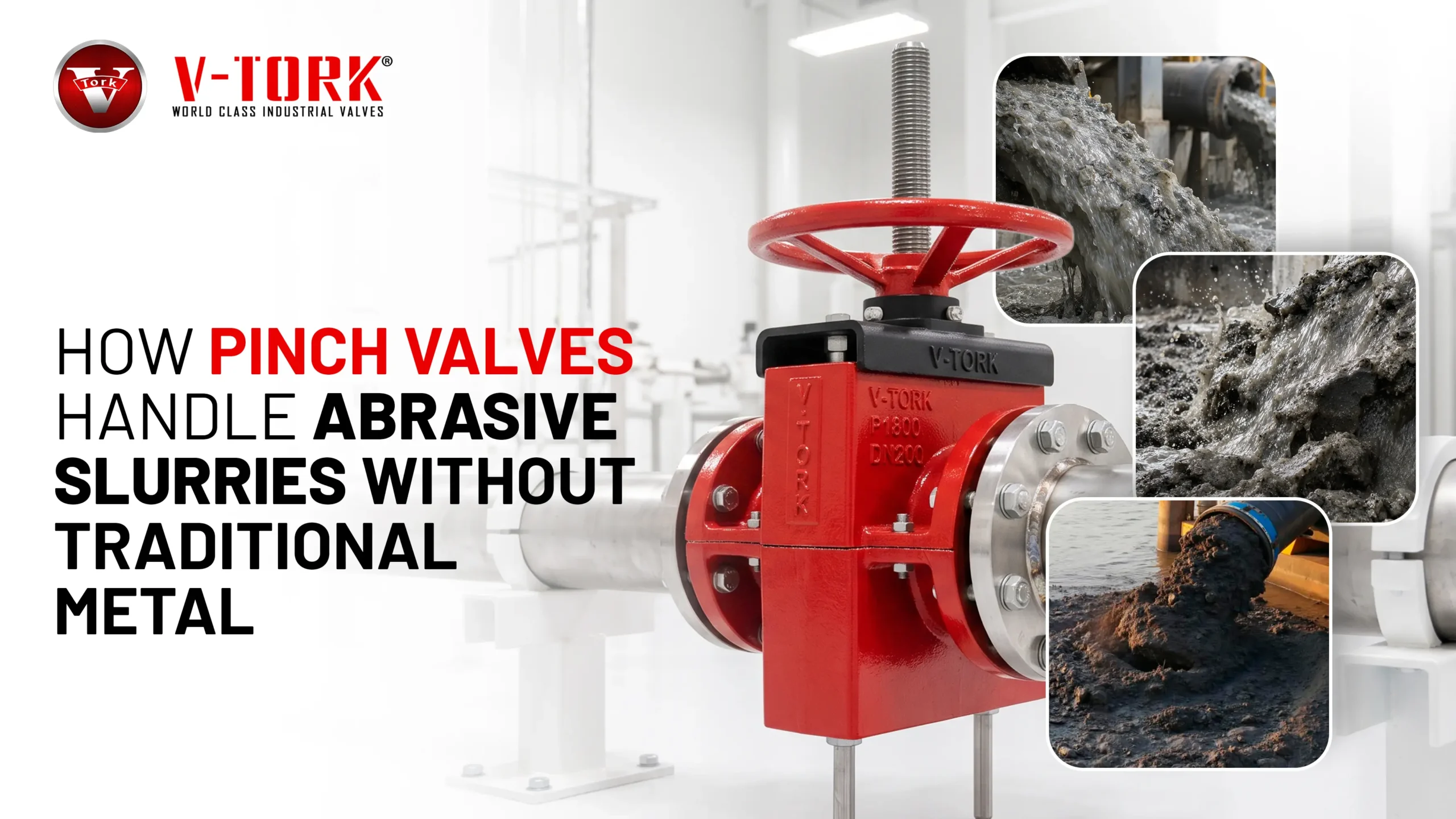
How Pinch Valves Handle Abrasive Slurries Without Traditional Metal
- Sleeve pinch valves are designed to handle abrasive slurry; all surfaces that come in contact with the media are rubber, not metal.
- Control pinch valves can throttle a slurry line as well, as long as you know what to watch.
- When comparing pinch valves manufacturers, ask about the sleeve first. The body matters less.
A valve wears out because something hard keeps hitting something hard. In a slurry line, that happens thousands of times a minute. Metal is tough, but slurry is all day. Pinch valves take a different route. Instead of building a harder surface, they take the metal out of the flow path. Here’s how that works, where it stops working, and what to check before you buy one.
Why Metal Struggles With Slurry
The most common valve type is one that has a disc or a seat within the flow path. When it hits with slurry, it does so at speed, and it does it in several ways. Over time, particles continue to hit the surface, eroding it and creating a thin surface. Impingement wears one spot hard, where the stream lands. And the results are familiar: leakage past the seat, restricted flow, and more maintenance than anyone budgeted for.
How Sleeve Pinch Valves Work Without Metal in the Flow
The flexible sleeve is the only component that comes in contact with the media. The body is located outside of it, as are the stem and the actuator. No scouring metal seat, no wearing down of disc.
The sleeve itself has three layers. The inner layer is a wear tube that takes the abrasion. A reinforcement layer of special-grade fabric holds the shape under pressure. The outer layer protects against the surroundings. Open, the bore is full and straight, with no ledge for solids to settle on. Closed, the walls push solids out of the sealing zone instead of trapping them against a seat.
When the sleeve does wear out, a two-piece body, like the one on our P-1800 model pinch valve, lets you replace it in the field.
Control Pinch Valves: Throttling a Slurry Line
Yes, a pinch valve can throttle. Partly closing the sleeve reduces the flow, and that’s all control duty really is. But there are two things to know first.
The flow doesn’t change evenly. At low openings, the flow area drops quickly, so the actuator and stroke need to be set up with that curve in mind. And at partial openings, the media speeds up at the pinch point, which is hard on a sleeve if the slurry is abrasive. That’s why the sleeve material gets chosen for the slurry, not picked at random. Our post on the flow characteristics of pinch valves goes into this in more detail.
If the duty is on-off, the sleeve lasts longer, because it isn’t sitting half closed against a moving stream.
Pinch Valves for Tubing vs Pipeline Pinch Valves
The small ones work on the same idea. They clamp a flexible tube from outside, and nothing else touches the fluid. You’ll find that style on dosing and sampling lines, and in lab setups.
Industrial slurry is a heavier job. It needs a reinforced sleeve held in a housing that can take the line pressure. Our range runs from 2 to 24 inches, Class 150, with flanged ends, and the valves are tested to API 598.
Where This Pays Off
Mining and mineral processing see the most use: abrasive slurries, ore beneficiation, and tailings. Sludge handling in water treatment is another, along with chemical plants running corrosive suspensions, power plants moving ash slurry, and paper mills with thick fibrous stock. We’ve covered each of these in Top 7 Industries that Benefit from Pinch Valves.
What to Check Before You Buy
Begin by starting with the sleeve. Abrasion slurry is typically natural rubber, and EPDM can be used with a greater variety of chemicals. Request in writing the temperature and pressure limits, as a nominal rating may mask limits for elastomer sleeves. Inquire about the time it takes to replace something, and ask how fast any spares can get to your site. And early resolve to actuate by a handwheel, by a gear, or by a pneumatic, hydraulic, or electric unit.
Final Thought
Pinch valves don’t beat abrasive slurry by being harder than it. They win by keeping metal out of its way. Get the sleeve right, and most of the rest follows.
At V-Tork Controls, we make pinch valves for mining, power, water treatment, chemical, and paper plants. Talk to pinch valve manufacturers who have handled your kind of media, and ask what sleeve they’d choose and why. We’re happy to answer that for your line. Our range covers pipelines from 2 to 24 inches. If you’re after pinch valves for tubing at bench scale, that’s a different product, and we’ll tell you so. Reach out to our team at vtorkcontrols.com.