
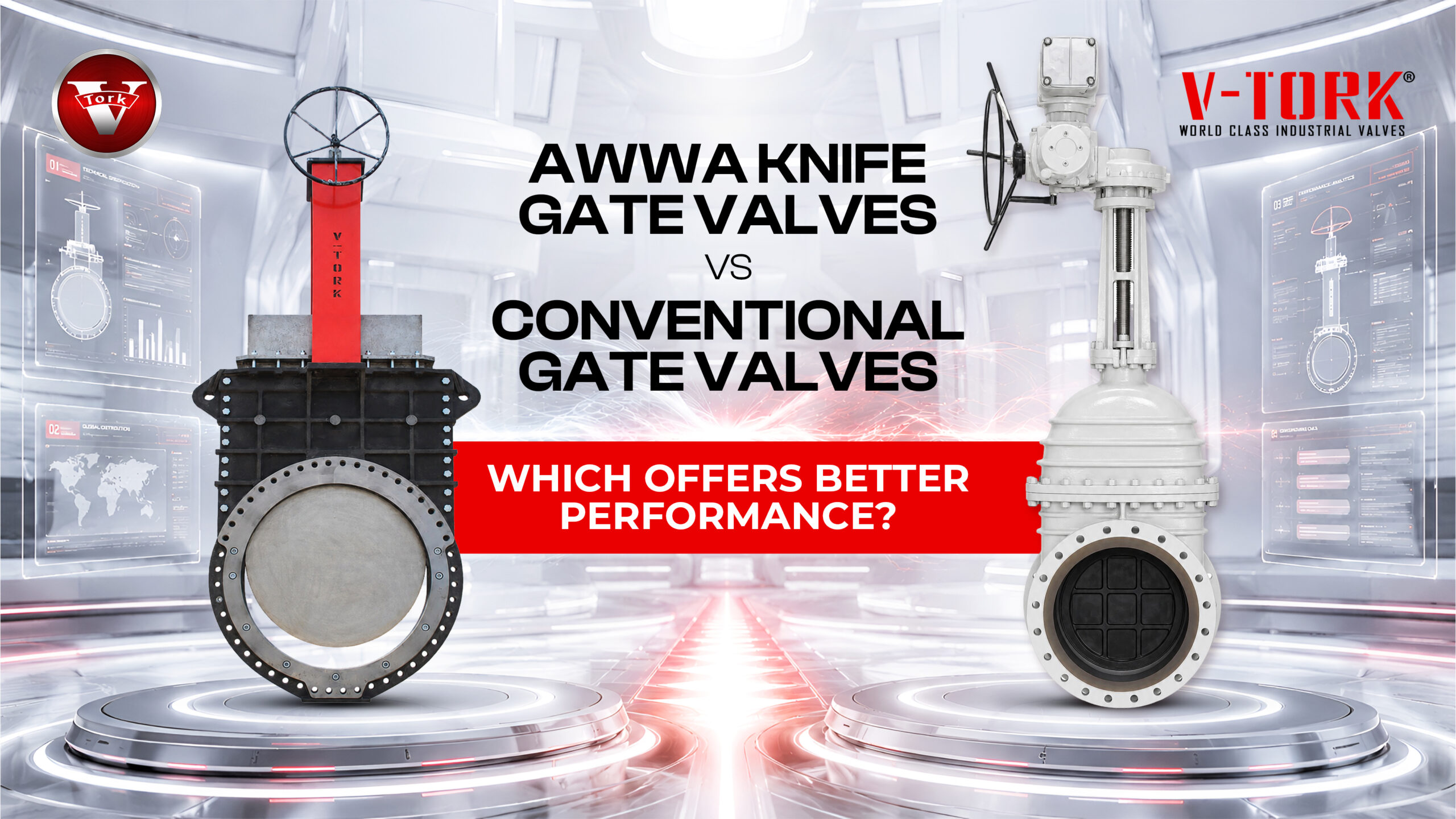
AWWA Knife Gate Valves vs Conventional Gate Valves: Which Offers Better Performance
The choice of valve technology when looking at flow control equipment for water, wastewater, or process flows has a significant impact on the long-term reliability, maintenance cost, and operational uptime of the system. Among the most frequently compared options in the industry are the AWWA knife gate valve and the conventional gate valve. While both can be used to isolate or regulate flow, their designs, sealing mechanisms, and suitability for different media are quite different. In this blog, we explain these differences and identify which valve usually performs better in real industrial conditions.
Understanding the Basic Design Difference
Conventional gate valves normally have a wedge-shaped disc that moves up and down within a body cavity to regulate the flow. Such an arrangement is fine for clean liquids; however, the disc and seat may get blocked when using slurries, sludge, or fibrous media, as the body cavity can accumulate debris, thus hindering sealing over time.
On the other hand, the knife gate valve is equipped with a thin, sharp-edged gate that goes through the flow way and cuts suspended solids while giving a tight shutoff. That makes it a natural choice for media with particulates or slurry, as its design largely prevents the accumulation of the material. Additionally, having a compact and lightweight body allows for easier installation even in limited spaces, unlike conventional gate valves that are usually large and bulky.
Where AWWA Compliance Adds Further Value
If we look at water systems in both municipal and industrial sectors, mere shutoff does not suffice in terms of performance. For these reasons, the AWWA knife gate valve is highly recommended. Constructed according to the AWWA C520 standard, valves in this group are designed for use with raw water, treated water, sewage, and sludge, where maintaining sealing and corrosion resistance throughout the valve’s service time is paramount.
They can be offered as bonneted or bonnetless in addition to one-piece or two-piece body constructions, according to the pressure and space needs of the piping system. Stainless steel, cast iron, or ductile iron are some of the usual body materials. Depending on whether the medium is abrasive, corrosive, or relatively clean, resilient or metal-seated designs can be selected. Such configurability is what enables water treatment plants to adapt the valve to the process conditions rather than using a generic shutoff device – something that conventional gate valves barely offer even at this level.
Comparing Performance Under Real Operating Conditions
In fact, the knife gate valve and in particular the AWWA-compliant one, continuously comes out on top for water-proximate and solids-containing applications in several aspects. The sealing performance is usually more dependable as the gate completely gets out of the flow path when open, leading to less exposure to abrasive wear. In contrast, conventional gate valves with their wedges often undergo more wear due to friction at the seat surface, especially when there are solids present in the line.
Another major factor is maintenance. For instance, bonnetless AWWA models and most knife gate valve designs in general allow disassembly for seat replacement without the need to extract the valve entirely from the main pipe; downtime is minimized for those industries that rely on continuous processes such as power generation, mining, paper and pulp, cement, and chemical processing. Generally, flow efficiency is in favor of knife gate valve design, especially in full-bore applications, as it causes hardly any obstruction when fully open, whereas disc and seat arrangements in conventional gate valves might cause more turbulence.
On the other hand, conventional gate valves still have a place in handling clean fluids at medium pressures where their less complex mechanical design makes them an effective and economically viable choice. Ultimately, the right choice would depend on the type of media, sealing needs, and the maintenance strategy a facility prefers.
Selecting the Right Valve for the Application
The AWWA knife gate valve and conventional gate valve selection criteria should be based on the adaptation of valve design to process requirements: type of media, pressure rating, and importance of minimum downtime. When it comes to raw water intake, sewage treatment, or sludge handling applications, the knife gate valve compliant with AWWA will, in many cases, be the better performer. As a direct industrial valve manufacturer, we consider these valve features not only from the valve point of view but also from the process to maximize the valve’s benefits and avoid early failures and unexpected downtime.
Final Thought
If you want to make the most of your investment in good gate valves, you need to determine the compatibility of the equipment design with the actual operating conditions, not just go along with the standard. For water, wastewater, or solids-laden media facilities, the knife gate valve, especially the one that is AWWA-compliant, is the one that outperforms in terms of sealing and is more reliable. Contact V-Tork Controls if your plant is considering valve options for water treatment or slurry handling and wants to identify the configuration that is the most suitable for your environment.