
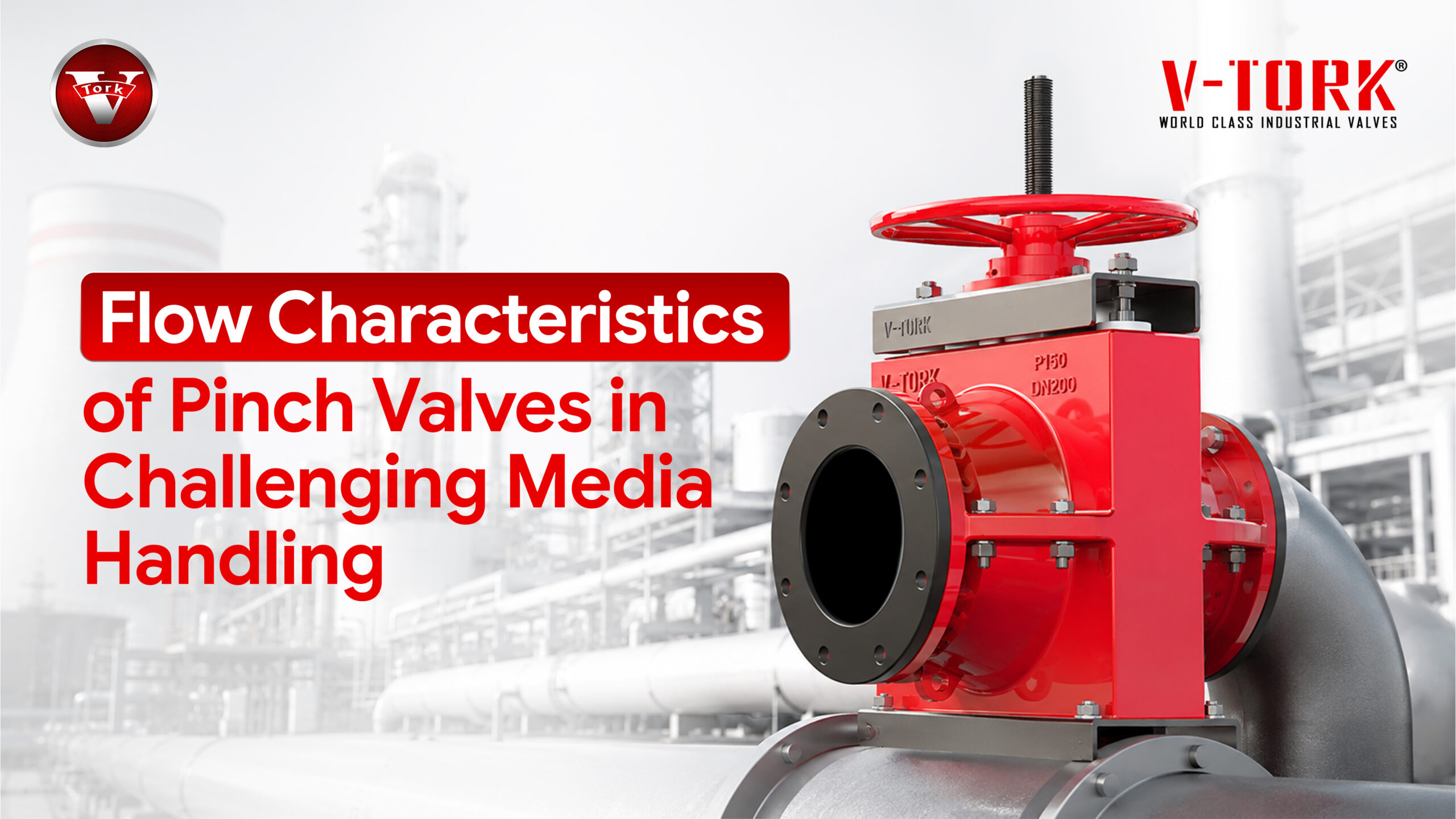
Flow Characteristics of Pinch Valves in Challenging Media Handling
When we talk about media that defies clean handling, abrasive slurries, corrosive chemical suspensions, ore tailings, sludge, and particulate-laden flows, the valve selection conversation shifts entirely. These are not environments where conventional valve geometries sustain reliable performance. The media itself dictates the design, and that is precisely where the flow characteristics of pinch valves become operationally relevant.
Why Flow Path Geometry Matters in Difficult Media
The main structural feature of a pinch valve is the full-bore, unobstructed flow path. Internally, an industrial pinch valve is designed to avoid any cavity traps, stem intrusions, or ledge surfaces where solids can settle and cause abrasion. The media passes through a straight elastomeric sleeve, so the valve does not disrupt the flow stream; it passes through it.
This full-bore design gets rid of turbulence exactly at the control point, which is very important when you are dealing with abrasive media. We must not forget that turbulence is also an issue of efficiency. On top of that, turbulence in slurries with a high content of solids leads to accelerated wear of the sleeve in different areas, causing pressure fluctuations and, eventually, the loss of tightness when the valve is closed. By having a straight and uninterrupted flow path, velocity distribution stays uniform throughout the bore cross-section, thus minimizing differential wear and extending service intervals.
Sleeve Behavior Under Operating Conditions
The sleeve is the functional heart of the pinch valve, and its multi-layer construction directly governs flow characteristics. The inner wear layer is designed to resist abrasion from continuous solid particle contact. Below that, a reinforcement layer, typically constructed from high-grade fabric, provides structural resistance against pressure-induced deformation, preventing sleeve ballooning that would alter the effective flow area. The outer layer then protects the assembly from the external environment.
Due to this layered construction, the sleeve is able to retain a steady bore geometry throughout its working range. Under actuation (pneumatic, hydraulic, or mechanical), when the sleeve deforms in a uniform manner, the throttling profile stays consistent. Being manufacturers who design for demanding slurry conditions, we understand that process controllability is directly related to the consistency of sleeve geometry.
Throttling Characteristics and Flow Modulation
Pinch valves exhibit an inherently non-linear flow characteristic when throttled. At low percentage openings, the cross-sectional area reduces rapidly, giving a quick-opening flow curve. This behavior is particularly useful in on-off isolation applications where full closure is achieved before significant wear accumulates on the sleeve. For proportional flow control in mineral processing or chemical dosing circuits, actuator selection and stroke calibration must account for this curve to achieve the intended Cv at each operating point.
In applications such as tailings treatment and ore beneficiation, industries where we, as experienced valve manufacturers, have deployed pinch valves extensively, the valve’s self-cleaning closure action is an additional flow-characteristic advantage. As the sleeve pinches closed, it displaces solids from the sealing zone rather than trapping them, resulting in reliable shut-off even in high-solids content streams.
Pressure Drop and Velocity Considerations
In the fully open position, the pressure drop across a pinch valve is minimal, comparable to a section of equivalent straight pipe. This is a significant operational advantage in long pipeline circuits where cumulative pressure losses affect pump sizing and energy consumption. For sludge handling in water treatment or chemical plant circuits, maintaining low pressure drop across isolation points reduces pumping load without sacrificing control.
However, at partial openings, the effective flow area constricts and local velocities increase substantially. In abrasive media, this velocity amplification at the pinch zone must be factored into sleeve material selection. This is why the choice between natural rubber and EPDM sleeves, as offered in our industrial pinch valves range, is not arbitrary; it is determined by the chemical and abrasive profile of the specific media in service.
Final Thought
Pinch valves secure their role in difficult media applications not by defying flow physics but by cooperating with it. The full-bore path, sleeve-based closure, and the fact that there are no flow-contact metal components result in a valve that can handle abrasive, corrosive, and particulate-laden media in a manner that other valve types cannot even come close to in terms of reliability, even over equivalent service lives.
If you are evaluating valve solutions for mineral processing, chemical, power, or slurry-intensive applications, we invite you to connect with our team at V-Tork Controls. As a dedicated pinch valve manufacturer with proven deployments across these sectors, we are positioned to recommend the right sleeve material, actuator configuration, and bore sizing for your specific flow conditions. Reach us at vtorkcontrols.com to discuss your application requirements.